Sunday, 21 April 2024

Exorcism for Headless Ghost: Part 1 - Coutts and Co Bank.

 Exorcism for Headless Ghost: Part 1 -

 Coutts and Co Bank.


In 1993, the world media reported on a headless ghost that was haunting Coutts & Co Bank. The bank is sometimes known as The Queen’s Bank (now King’s) as the Royal Family are customers.  Coutts & Co. was founded in 1692. The bank's headquarters has been located at 440 Strand in London since the late 1970s, in a building constructed in the 1820s.

 In 1992, several female employees began to complain of a ghost. Computers and electric lighting would fail, the temperature would plummet, and a shadowy figure would be seen floating through the building. A receptionist reported witnessing a full-bodied apparition crossing the atrium floor, which she knew as a ghost. After this experience, many female employees refused to work in the building.[1]
 Meanwhile, other employees in the building were reporting a headless phantom at the bank entrances, coinciding with temperature drops. This apparition was most often seen during the day and early evening.[2]

 The bank sought someone to investigate the alleged haunting. They contacted the College of Psychic Studies in Kensington, which recommended Eddie Burks. During his investigation, Burks held a séance. He claimed he contacted Thomas Howard, who told him, ‘I was beheaded on a summer’s day… I have held much bitterness and…I must let this go. In the name of God, I ask your help…’[3]

After the story broke in the media, a Jesuit priest and member of the Royal Historical Society, Father Francis Edwards, identified the headless ghost as Thomas Howard, the fourth Duke of Norfolk. Howard was married to the daughter of the 12th Earl of Arundel and was widowed in 1557.

Next week, the story continues with Exorcism for Headless Ghost: Part 2

Researched and written by Allen Tiller. © 2024


[1] Burks, Eddie & Cribbs, Gillian. Ghosthunter: Investigating the World of Ghosts and Spirits, (1995), pp. 37-57.

[2] Rosemary Ellen Guiley, ‘The Encyclopedia of Ghosts and Spirits, (2007).

[3] Burks & Cribbs, Ghosthunter (1995), pp. 37-57.

Sunday, 31 March 2024

Ghost Materialises for Communion

Ghost Materialises for Communion


The Canberra Times reported in 1971 that a ghost appeared during a communion service at an 11th-century village church in Hartley, England. Reverend Roger Williams could only watch in awe as a hooded figure, with its arms crossed on its breast, manifested on a wall, then slowly vanished from sight. The parishioners gasped in awe at the apparition, but the Reverend soon explained the miracle.

He explained that after the 16th century, English churches broke away from Rome, and many mural paintings of saints and scenery were whitewashed over during the Reformation. The church had recently installed central heating. The church suffered from dampness, and as the central heating kicked in, the heat and damp contributed to exposing a mural that had been whitewashed – thus not a ghost![1]

researched and written by Allen Tiller © 2024

[1] 'Ghost materialises for Communion', The Canberra Times, (4 January 1971), p. 6.

Sunday, 3 March 2024

Murderers Headless Ghost Haunts Saint Auvent, France.


Murderers Headless Ghost Haunts 

Saint Auvent, France.

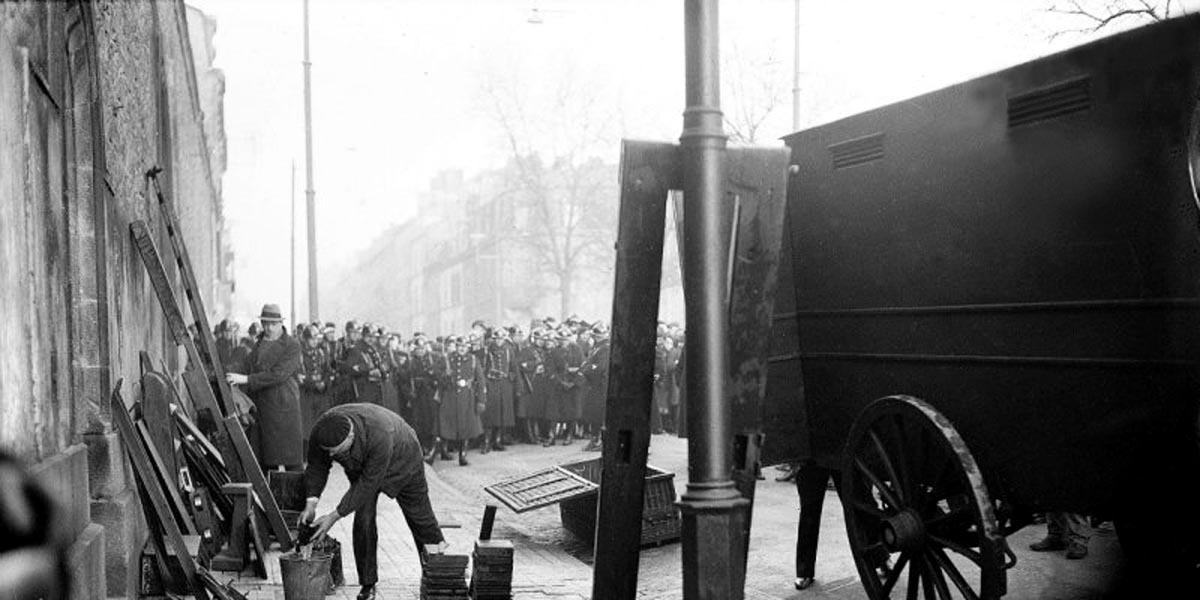
This scene takes place on the sidewalk in front of the Maison d'Arret in Limoges on March 3rd, 1937. Henri Dardillac, a 27-year-old farmer, has been executed about an hour ago and Deibler's team is preparing to load the guillotine back into the fourgon which has just returned from the cemetery. Henri Sabin is dipping a sponge in a water bucket to wash blood off a part, while André Obrecht is preparing to load another into the carriage.

Source: http://boisdejustice.com/History/Dardillac1937.JPG


December 1st, 1936, 27-year-old Henri Dardillac was driven home by a wine merchant named Martial Fredon, with another passenger in the car. They had attended a Cognac Fair, and the wine merchant had made a huge sum of money. Dardillac witnessed the wine merchant’s wallet and decided he wanted it for himself. He brutally murdered the wine merchant and the other passenger, an old man. Dardillac was eventually captured for the murders, but the wallet of money was never recovered.


 On 3 March 1937, Henri Dardillac heard Mass at the Maison d'Arret in Limoges (located today at 17 Winston Churchill Place.) His lawyer came to see him, and the executioner. The guillotine was waiting on the street outside the prison, with 10, 000 spectators waiting to witness the beheading of Dardillac. He was marched through the gates of the prison, placed into the device, and within minutes, the blade dropped and ended his life. The crowd cheered and whistled at the sight. Henri Dardillac becomes the 385th client of the Limoges executioner. He was the last to be guillotined in a public square.[1]

In 1937, cable news in Australia reported that a French village was being haunted by an executed murderer. The convicted murderer was guillotined at the beginning of 1937 at Saint-Auvent, near Limoges in west-central France.

The family of the murderer, his wife and two children reported a haunting in their home. They heard eerie noises, knocking, loud stamping, the rattle of chains and the chinking sound of broken glass from the garret (attic or loft) between 9pm and midnight, every night.
  Fearing that local people were terrorising the family, armed police began to guard the home, and they too heard the unusual noises. When the police went to investigate the sounds, they suddenly ceased. A priest was called into the home. He went into the garret and blessed it with holy water. It was afterwards reported that the noises continued but were much more subdued.[2]


Researched and written by Allen Tiller ©2024

[1] ‘80 years ago, the guillotine cut off its last head in a public square in Limoges,’ Le Populaire, Du Centre, (2017), https://www.lepopulaire.fr/limoges-87000/politique/il-y-a-80-ans-la-guillotine-tranchait-sa-derniere-tete-en-place-publique-a-limoges_12305432/.

[2] 'Headless Ghost of Murderer', Northern Standard, (16 April 1937), p. 12.


Sunday, 25 February 2024

Kundiawa, Guitar Playing Ghost - Papua New Guinea

Kundiawa, Guitar Playing Ghost

 - Papua New Guinea


In 1965, it was reported that the ghost of an Australian Army lieutenant was haunting the hamlet of Kundiawa in the New Guinea Highlands. It was claimed that the ghost had been identified as Lieutenant George Charlton Tuckey.

Tuckey died in 1945 while serving with the Angau Administration at Kundiawa and was buried in a local cemetery.

Police Corporal Arambi reported that he often heard guitar music coming from inside a police inspector's house. There were no signs of life in the home, which was in total darkness. Arambi investigated the grounds and the house but could find no source for the music. However, as he neared Tuckey's grave, he noticed that the music ceased.

Arambi later claimed that he saw the ghost. It was wearing a white shirt and shorts. He knew Tuckey, having worked with him for two years, and identified the apparition as him. Tuckey's ghost shuffled through the compound, and Arambi followed it into the Kundiawa courthouse, where it disappeared.


Researched and written by Allen Tiller © 2024

[1] 'Guitar-playing ghost now walks about', The Canberra Times, (6 May 1965), p. 22.


Wednesday, 7 February 2024

The Petrified Woman


The Petrified Woman


I borrowed this book from the Gawler Libraries yesterday and read it last night. A true crime story from our very own Riverland, in the Renmark/ Murtho region.
The story centres on the finding of a petrified female body. The body has no teeth, fingers or toes and most of its face is missing. Detectives believe they know who she is, and who murdered her, but they never solved the case. Now, much like Somerton Man, DNA would solve the mystery - the author traced the pauper's grave to West Terrace Cemetery, and through a direct descendant of the suspected murdered woman, applied to have the body exhumed for DNA testing...but, successive Governments have ignored or denied the process...
The book is available for loan through your local library at Libraries SA


Monday, 29 January 2024

The Haunted Wardrobe – Oxfordshire, England.

The Haunted Wardrobe – Oxfordshire, England.


In 1937, the Northern Standard, a Northern Territory newspaper, reported on the case of a haunted wardrobe in Oxfordshire, England. Mrs Barclay of Carterton Manor, Oxon, had advertised in the Morning Post, an English newspaper, that she was selling a haunted wardrobe.

Barclay explained that she had purchased the wardrobe for ten pounds at a sale. Three months later, after bringing it into her home, the wardrobe's doors and drawers began opening and closing of their own volition, causing a considerable ruckus. Not long afterwards, she claimed to have witnessed the ghost of an elderly man. Barclay stated that "the figure of an elderly man, dressed in old-fashioned clothes and wearing a kind of deerstalker cap, appeared in the house." Every evening, the ghost would walk from the bedroom, down the stairs, and out the front door.[1]

Barclay stated in an interview, "I am not nervous, but the wretched ghost makes such a noise. He clatters across the landing and shuffles down the stairs, and the noise is exasperatingly loud."[2] Barclay also claimed that the ghost had terrified her cook and frightened him away.[3]

The night before the auction, Mrs Barclay claimed that the ghost was upset about the sale. He banged the wardrobe doors with more than his usual venom. The wardrobe clattered down the stairs more loudly than she had ever heard it before, prompting her to have it removed to the manor grounds.

That evening, a group of practical jokers dressed as ghosts invaded Carterton Manor and refused to leave until Mrs Barclay's secretary dispersed them by firing a shotgun.[4]

Mrs Barclay subsequently auctioned the wardrobe. During the sale, a bidder asked whether she could guarantee that the ghost would accompany the wardrobe, to which she replied that she could not. Bidding drove the price well beyond the ten pounds she had originally paid for it. Mr E. Rundle, a former R.A.F. officer and innkeeper, eventually purchased the haunted wardrobe from Mrs Barclay for fifty pounds.[5]

After making the purchase, Rundle stated, "I am having my bedroom enlarged and am having the wardrobe put in it. Anyone who wants to do so may sleep there. Personally, I do not believe in ghosts."[6]

Rundle took the wardrobe to his Clanfield inn and soon reported experiencing the same strange occurrences. As a sceptic, he decided to dismantle the Victorian-era wardrobe to investigate why its doors and drawers opened of their own accord. Finding no hidden mechanisms or other explanation for the wardrobe's behaviour, Rundle concluded his investigation and carefully restored it. Following its restoration, he reported that it never behaved in the same manner again.

Researched and written by Allen Tiller © 2024

[1] 'A Haunted Wardrobe Complete with Ghost', The Catholic Advocate, (25 November 1937), p. 6.

[2] Ibid.

[3] 'Haunted Wardrobe', The Argus, (21 August 1937), p. 13.

[4] '£50 Highest Bid for Haunted Wardrobe', Lachlander and Condobolin and Western Districts Recorder, (6 September 1937), p. 6.

[5] Ibid.

[6] 'HAUNTED WARDROBE FETCHES £50', Northern Standard, (31 August 1937), p. 4.

Wednesday, 17 January 2024

Haunted Adelaide Plains South Australia - BOOK!


Haunted Adelaide Plains
South Australia


On dark and stormy nights, a phantom walks Port Wakefield Road, hitchhiking to Adelaide. He wears a long, Australian Air Force jacket, with a RAAF uniform underneath. He hitches a ride, and then vanishes from the car…who is this ghost that has been reported since the 1940s? Is he the only ghost walking Port Wakefield Road, and what other spectres are seen in the area?In Haunted Adelaide Plains: South Australia, award-winning historian and paranormal investigator, Allen Tiller investigates this ghost story, and others from the region; including the ghost of a soldier in Mallala, phantoms in Alma, Balaklava, Dublin, Pinery, and Two Wells… and, an unusual sighting of Princess Diana in Mallala at the time of her death.

Allen Tiller focuses his research on true ghost stories drawn from historical sources, interviews, witness statements and his own paranormal investigations. Allen Tiller is a former volunteer at the Mallala Museum and the Adelaide Plains Historical Committee. His family are pioneers in the region and can be linked to two hauntings on the Adelaide Plains, which Allen discusses in this book.
Haunted Adelaide Plains: South Australia, investigates the paranormal through fact-checked historical information that adds authenticity to some stories and debunks others; valuing evidence-based stories over psychic hearsay and giving an unbiased, factual account of local hauntings on the Adelaide Plains.

Buy it here: