Showing posts with label France. Show all posts

Sunday, 3 March 2024

Murderers Headless Ghost Haunts Saint Auvent, France.


Murderers Headless Ghost Haunts 

Saint Auvent, France.

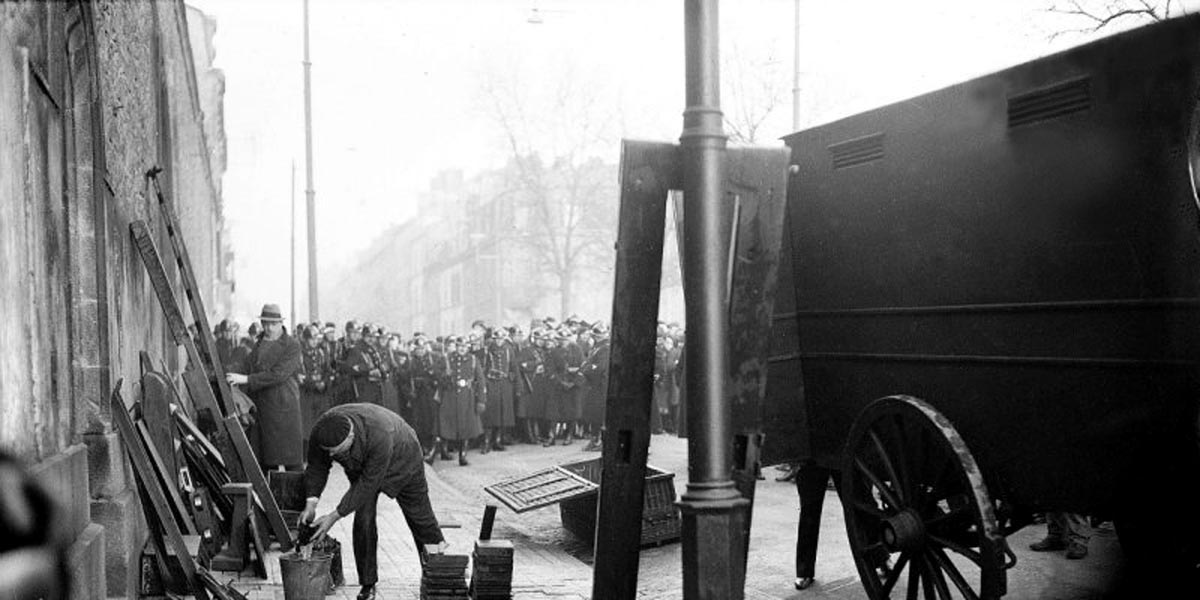
This scene takes place on the sidewalk in front of the Maison d'Arret in Limoges on March 3rd, 1937. Henri Dardillac, a 27-year-old farmer, has been executed about an hour ago and Deibler's team is preparing to load the guillotine back into the fourgon which has just returned from the cemetery. Henri Sabin is dipping a sponge in a water bucket to wash blood off a part, while André Obrecht is preparing to load another into the carriage.

Source: http://boisdejustice.com/History/Dardillac1937.JPG


December 1st, 1936, 27-year-old Henri Dardillac was driven home by a wine merchant named Martial Fredon, with another passenger in the car. They had attended a Cognac Fair, and the wine merchant had made a huge sum of money. Dardillac witnessed the wine merchant’s wallet and decided he wanted it for himself. He brutally murdered the wine merchant and the other passenger, an old man. Dardillac was eventually captured for the murders, but the wallet of money was never recovered.


 On 3 March 1937, Henri Dardillac heard Mass at the Maison d'Arret in Limoges (located today at 17 Winston Churchill Place.) His lawyer came to see him, and the executioner. The guillotine was waiting on the street outside the prison, with 10, 000 spectators waiting to witness the beheading of Dardillac. He was marched through the gates of the prison, placed into the device, and within minutes, the blade dropped and ended his life. The crowd cheered and whistled at the sight. Henri Dardillac becomes the 385th client of the Limoges executioner. He was the last to be guillotined in a public square.[1]

In 1937, cable news in Australia reported that a French village was being haunted by an executed murderer. The convicted murderer was guillotined at the beginning of 1937 at Saint-Auvent, near Limoges in west-central France.

The family of the murderer, his wife and two children reported a haunting in their home. They heard eerie noises, knocking, loud stamping, the rattle of chains and the chinking sound of broken glass from the garret (attic or loft) between 9pm and midnight, every night.
  Fearing that local people were terrorising the family, armed police began to guard the home, and they too heard the unusual noises. When the police went to investigate the sounds, they suddenly ceased. A priest was called into the home. He went into the garret and blessed it with holy water. It was afterwards reported that the noises continued but were much more subdued.[2]


Researched and written by Allen Tiller ©2024

[1] ‘80 years ago, the guillotine cut off its last head in a public square in Limoges,’ Le Populaire, Du Centre, (2017), https://www.lepopulaire.fr/limoges-87000/politique/il-y-a-80-ans-la-guillotine-tranchait-sa-derniere-tete-en-place-publique-a-limoges_12305432/.

[2] 'Headless Ghost of Murderer', Northern Standard, (16 April 1937), p. 12.


Thursday, 13 December 2018

Pere Fouettard – Father Whipper

Pere Fouettard – Father Whipper


Pere Fouettard is a French Anti-Santa that arrives on St Nicholas Day to punish naughty children by whipping them. Le Père Fouettard is depicted in red and black clothing, perhaps a throwback to his anti-Roman roots.

The whipping Father has his roots in the 16th-century medieval siege in the city of Metz, a war between the Holy Roman Empire and Henry II of France. The war lasted for 8 years, and during holiday seasons, effigies of the Roman Emperor were made and dragged through the street. Local tanners would whip the effigy as it passed, thus creating Father Whipper in the imaginations of generations to come.

Tuesday, 30 May 2017

History's Mysteries: Carnac Stones

Carnac Stones


3,000 megalithic stones arranged in perfect lines over a distance of 12 kilometres on the coast of Brittany in the North-West of France make the awe-inspiring sight of the Carnac Stones.
Myths abound around these stones, the most well know myth being that each stone represents a Roman Legion turned to stone by the Wizard Merlin, another myth involves pagan soldiers in pursuit of Pope Cornelius turning the pagans into stone.
The stones are dated to around 4500BC, it is unknown who built them or why.


http://en.wikipedia.org/wiki/Carnac_stones
http://www.sacred-destinations.com/france/carnac-stones

©2013 – Allen Tiller
First published in 2012
www.eidolonparanormal.com.au

Wednesday, 22 July 2015

St Mary Magdalene - “the sinner from whom Jesus had cast out seven demons”


St Mary Magdalene - “the sinner from whom Jesus had cast out seven demons”

 Born into a wealthy family, in fact, she was royalty, with her parents and brother Lazarus and Sister Martha, they owned, and lived in a castle, just two miles from the Sea Genezareth. They also owned the village of Bethany, near Jerusalem.


 Like all wealthy people of the time, they indulged in carnal pleasures, gluttony and other earthly sins.
 Mary was known to enjoy the bodily pleasures her wealth and beauty brought her, and through her constant quest for pleasure, soon found her good name gone, to be replaced in the streets as merely “The Sinner”.

  Mary soon became a lady of the streets, and in time found herself in the house of Simon the Leper as Jesus himself visited. Mary, not wanting to sit amongst the just, Mary walked up to Jesus, washed his feet with her tears, dried his feet with her hair and anointed them.

 Jesus gave much to Mary Magdalene, he expelled seven evil spirits from her. She became a loyal friend and supporter and helped Jesus upon his journey. He defended her against the Pharisee who called her impure, against her own sister who accused her of being idle, and against Judas, her accused Mary of being a spendthrift.
 Jesus also raised her brother Lazarus from the grave, four days after his death, and cured her sister Martha of hemorrhages that had plagued her for seven years

 Mary followed Jesus from Magdala in Galilee to Bethany in Judea, and later to Cavalry, where she watched on as our Lord was forced to bear his cross, and then was crucified. She sat at the foot of his cross as he suffered for our sins. She was it his tomb when he was buried and was the last to leave.
Mary was also the first person to which Jesus appeared upon his resurrection on Easter Sunday – and was heard to utter “Christ Has Risen!” – Which still echoes through time today for all Christians

Mary Magdalene went from the great sinner to Saint, and the “Apostles of the Apostles”, and after the resurrection of Jesus, she continued to preach his word.
 
When the persecutions started around 42 AD, the people of the Church of Jerusalem scattered amongst the Roman Empire around the Mediterranean Sea, into Greece, Italy Spain and Gaul (France). 
Mary, Lazarus, Mary Salome and Mary Jacoby, disciples Maximin and Sidonius were all forced onto a ship with no sails, oars or supplies and set to sea. The ship floated across the Mediterranean Sea and eventually found its way a port called Rha (France) that later became known as Saintes-Maries-de-la-Mer (Holy Marys of the Sea).

 The group continued to deliver the gospel in their new found home, with Lazarus baptizing new Christians at every chance.
 Soon the group split up with Mary Salome, Mary Jacoby and Marcella remaining in Rha while the others made their way overland to Massilia (Marseille). Martha soon left for Tarascon, and Maximin for Aix.
 Lazarus would remain in Massilia, eventually becoming the cities first Bishop, whilst Mary and Sidonius travelled to La Sainte Baume.
 Mary and Sidonius discovered a large natural cave in La Saint Baume, which they would make their home, and where Mary Magdalene would see out her final days in Penance.
 Mary would spend the next 30 years meditating in solitude, other than the seven angels who would visit her daily. The Angles would take Mary to the top of the mountain she was living under, to hear the sounds of music from heaven, and to take in the view that allowed her to see out to the Mediterranean Sea. It is said in the 30 years she spent in the cave, Mary did not drink water, nor eat.
 After 30 years of longing to be reunited with Jesus, the day finally came when the Lord enlightened her that her death was near. The Lord guided her to the village of Villalta, and along the way, she was met by Maximin, who had been divinely inspired to meet her and lead her Church. At the very spot they met, there was a pillar – which still stands today.
 Mary Magdalene received Holy Communion from Maximin in the new Church, and fell lifeless, before him at the altar. The year was 72 AD.
 Mary was buried with great pomp and dignity in an alabaster tomb near the Church, upon her death it was noted the Church, and her body gave pf a sweet perfume – this is often associated with the holiest of people and incorruptible bodies.

A century and more passed, and in 1279, an excavation of a crypt under St Maximin in France, Charles II, The Count of Province, discovered a sarcophagus made of marble, which upon opening smelled distinctly perfumed which the Count believed may have been something similar to the perfume Mary Magdalene had anointed the feet of Jesus with.

 The skeletal remains were missing the lower leg bones and the jaw, and were found with a note on papyrus which read:

The year of the birth of the Lord 710, the sixth day of December, at night and very secretly, under the reign of the very pious Eudes, king of the Franks, during the time of the ravages of the treacherous nation of the Saracens, the body of the dear and venerable St. Mary Magdalene was, for fear of the said treacherous nation, moved from her alabaster tomb to the marble tomb, after having removed the body of Sidonius, because it was more hidden.

There was also a wood tablet covered in wax, inscribed with the words “Hic requiescat corpus beatae Mariae Magdalenae.” It was estimated to be made between the 1st and 4th centuries.

To honour his great find, Charles II built the Basilica; “Saint-Maximin-la-Sainte-Baume”, in place of the old church. The relics of Saint Mary, including her jawbone, which had been venerated in Rome for the previous Millennia, and returned by Pope Boniface VIII, were put on display in a unique gold reliquary
 Every year, on Sunday closest to the 22nd of July, Saint Mary Magdalene’s remains, affixed with a gold mask upon the reliquary, are carried around the town to celebrate her life and her sacrifices to Jesus.
Another Holy Relic of Saint Mary Magdalene is one of her teeth, displayed in the New York Metropolitan Museum of Art

Thursday, 8 January 2015

ANGELIQUE COTTIN, THE ELECTRIC GIRL

ANGELIQUE COTTIN, THE ELECTRIC GIRL


At 14 years of age, Angelique Cotton, from the Normandy region of France, became a sensation amongst her peers and the local townsfolk when poltergeist-like activity began to happen within her vicinity.  Nicknamed the “Electric Girl” witnesses described seeing large tables float across rooms she was in. On one occasion an old metal weaving loom and frame 'danced' across a floor in her presence. Chairs would shoot across the room when she tried to sit, and beds would drag across the floor.
 When she lifted her left hand as if on command, pens and papers would shoot across the table.
Anyone getting close to Angelique would also receive a painful electric shock, making her already odd life a lonely one, not being to experience the touch of friends and family.
It wasn't uncommon for Angelique to suffer from fits or convulsions, and writhe and twist in pain and agony, which led her family to visit the local priest and ask for an exorcism.
 The Father convinced the family the strange goings-on were not of the spiritual world, nor demons, but of the physical world, and most likely had a plausible explanation.

 Angelique was then taken to Paris to be studied by the finest doctors and scientists the city could muster, which led to the famous physicist Francois Arago examining the child. Arago declared that the effects on the young Angelique were a genuine physical world phenomenon caused by electromagnetism.

Angelique's parents were then convinced to make money from Angelique's condition and offered her a sideshow exhibit. Then just as suddenly as her electromagnetic powers had appeared, they abruptly stopped in April 1846, and young Angelique returned to a normal life.

written by Allen Tiller

Wednesday, 3 April 2013

“Eat him if you want!” The Murder of Alain de Money's


“Eat him if you want!”The Murder of Alain de Money's

France was losing the war with Prussia in 1870, Emperor Napoleon II had just been captured and his regime overthrown by a self-proclaimed government for National Defence. The walls of social order were crumbling in on themselves, and a young aristocrat was about to become one of the focal points of Frances most gruesome acts.

Hautefaye, in southwestern France, was the setting for the grisly act of violence that will forever stain the area.

With the war not going well, a long-lasting drought, and hate for nobility, the illiterate peasants of Hautefaye were a resentful bunch and didn't like the fact that they had to get their news about the war from Noblemen.
At a rural fair (of sorts) outside the town, more than 200 peasants had gathered to trade, Alain de Money had brought the news of the war not tiding well for France, the peasants didn't take it so well and grew unruly.

The Vicomte Camille Maillard Lafaye, some of the Mayor of a nearby town, was present at the trading grounds, he and his party were attacked by the unruly mob, and fled for their lives. The crowd, now heated, bearing pitchforks, cudgels and whatever weapons they could brandish now turned their anger turned towards Alain.

Alain was accused of being a Prussian spy, of financing a war against France, or treason and any other crime the mob could think up. The Parish priest tried to intervene between the mob and Alain, but he soon realised that he was well overpowered, and left for sanctuary in his Church.
The Mayor, who was unsure of what to tell the drunken mob to stop the brutal attack about to ensue, added more flames to fire by shouting “Eat him if you want!”

For the next two hours Alain was tortured by more than 200 people in the mob, some as young as 14 years old. He was stabbed with pitchforks, sliced with hooks, whipped, kicked, punched and bludgeoned before it was decided to tie him to a blacksmiths workbench, where he was beaten from behind with a hook.
He had horseshoes nailed to his feet and one of his eyeballs was burst from its socket, after this ordeal it was decided to burn him.

A large pile of grass and wood was made and Alain's body was thrown on top, a young child lit the bonfire, and the crowd continued to whip, punch and bludgeon Alain even as he burnt in front of them. Some of the people are said to have collected the fat melting from his burning body, and collect it on bread, eating it as they watched.


 Some of the men did not escape punishment for their crimes against Alain De Money's, fifty people were arrested, ranging in age from 14 to 60. 19  of the people were convicted, one to spend life in jail, the rest got 6 to 8 years hard labour and four men, considered the ringleaders were sentenced to death by guillotine.


© 2013 Allen Tiller

www.eidolonparanormal.com.au